About this workshop
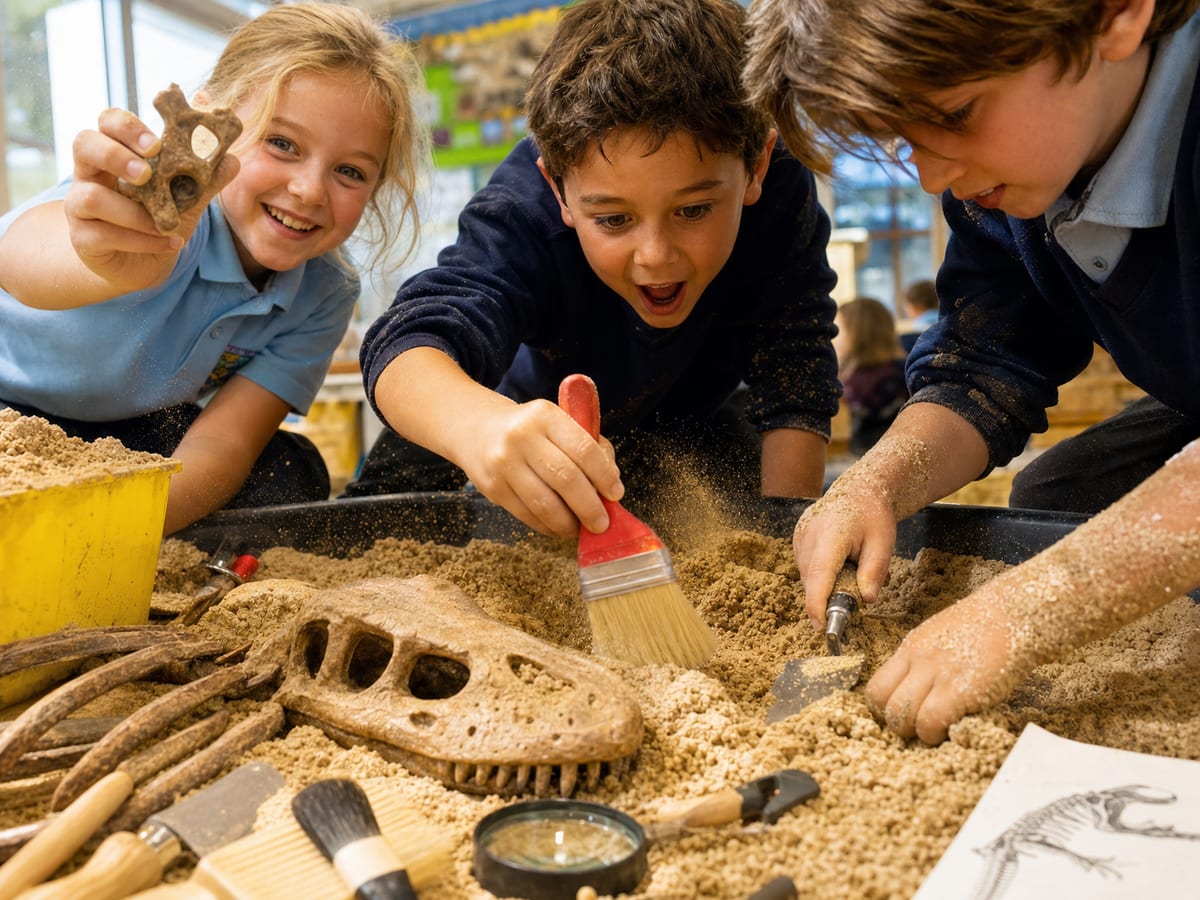
Our fossil dig awaits your school with prehistoric thrills. Inside large sandboxes, children hunt down and identify fossils from the most legendary dinosaurs that ever lived - Tyrannosaurus Rex, Stegosaurus, Triceratops and other ancient beasts waiting to be uncovered.
This is a palaeontology workshop with a fully interactive dig site. Pupils excavate carefully, record what they find, and work out what a fossil can tell us about an animal nobody has ever seen alive.
A favourite for British Science Week and for schools building a whole topic around fossils and prehistoric life.
How the session runs
What happens
- 01
What dinosaurs were
Firstly we discover what a dinosaur actually was - a group far stranger and more varied than T. Rex and Triceratops suggest. Some hunted, some grazed, some walked on two legs and some on four, and birds are living dinosaurs.
- 02
When they lived
Next we work out when. Dinosaurs ruled for around 165 million years; humans have managed roughly 200,000. The class stretches string across the room to compare the two, and finds Earth was busy with life long before either.
- 03
The world they lived in
Then we look at the map they knew, which was nothing like ours. Most continents were joined as Pangaea, with no Atlantic and no Alps, and the plates carrying them apart still move at about the rate fingernails grow.
- 04
How we know: fossils
No one has ever seen a living dinosaur, so we rely on fossils instead. Pupils discover how rapid burial preserves the remains, how minerals turn bone to stone, and why fossilisation requires such exacting conditions - leaving the fossil record full of gaps.
- 05
Reading the evidence
Now we read what fossils say. Teeth reveal diet, footprints reveal movement and herds, and coprolites - fossilised droppings - give away the last meal. Eggs and nests show even the giants started small.
- 06
Meeting the giants
Finally we meet them at full size. Pupils stand their feet inside a T. rex print, hold a human backbone beside an Argentinosaurus one, and compare a ball with an egg to see that a huge body never meant a huge brain.
What pupils will learn
The science they take away
Starting with your curriculum objectives, we’ve designed an interactive, fact-packed workshop that pupils will remember for years to come.
- 01How fossils are formed and why they are comparatively rare
- 02How palaeontologists excavate and record a site
- 03To identify major dinosaur species from their remains
- 04What teeth and claws reveal about diet and behaviour
- 05How rocks and fossils give evidence of living things from millions of years ago
- 06The vocabulary of palaeontology used in context
Curriculum links
What this covers in the National Curriculum
Science - Evolution and inheritance
- Understand that palaeontologists study prehistoric life using fossils and other evidence.
- Understand that dinosaurs were a diverse group that lived approximately 230-65 million years ago, for around 165 million years.
- Understand that the continents have moved over millions of years, and that Earth looked very different in the age of the dinosaurs.
- Understand how fossils form, and recognise the different types of fossil evidence - bones, teeth, footprints, skin, plants, eggs and coprolites.
- Use fossil evidence, including footprints, to draw conclusions about a dinosaur’s size, movement and behaviour.
- Understand that scientific knowledge changes as new evidence is found, and that some things - such as dinosaur colour - remain uncertain.
In your school
Brushes, not hands. Slow, not fast. Exactly how a real dig works.
Logistics
What we bring, what you need
We bring
- Large excavation sandboxes and all the sand
- Replica fossils, casts and reference material
- Brushes, trowels and recording sheets for every pupil
- A DBS-checked facilitator to lead every session
You provide
- A hall or large space that can take the sandboxes
- A parking space close by to unload
- A member of school staff present in each session
Questions schools ask
Before you book
- How much mess does the sand make?
- The boxes are contained and we sweep up after every session. Halls are handed back clean.
- Do the children keep anything?
- The fossils are reference pieces and stay with us, but we leave classroom follow-up activities behind.
- Does it work with Reception?
- Yes. The dig is adapted for EYFS with more handling and less recording.
- Can it run outdoors?
- It can, but indoors is more reliable in British weather and the sand behaves better.
Feedback from schools
What schools said
Five-star Google reviews of Education Group, who deliver our workshops. Reviews naming this workshop come first.
This was an amazing workshop that the children absolutely loved. Ian engaged all the children in their learning. They loved the fossils and of course the baby dinosaurs. Thank you Ian for bringing this topic to life.
The dinosaur workshop was brilliant. Perfectly adapted for and aimed at our YR children - they learnt lots and was great for them to have hands-on experience of fossils.
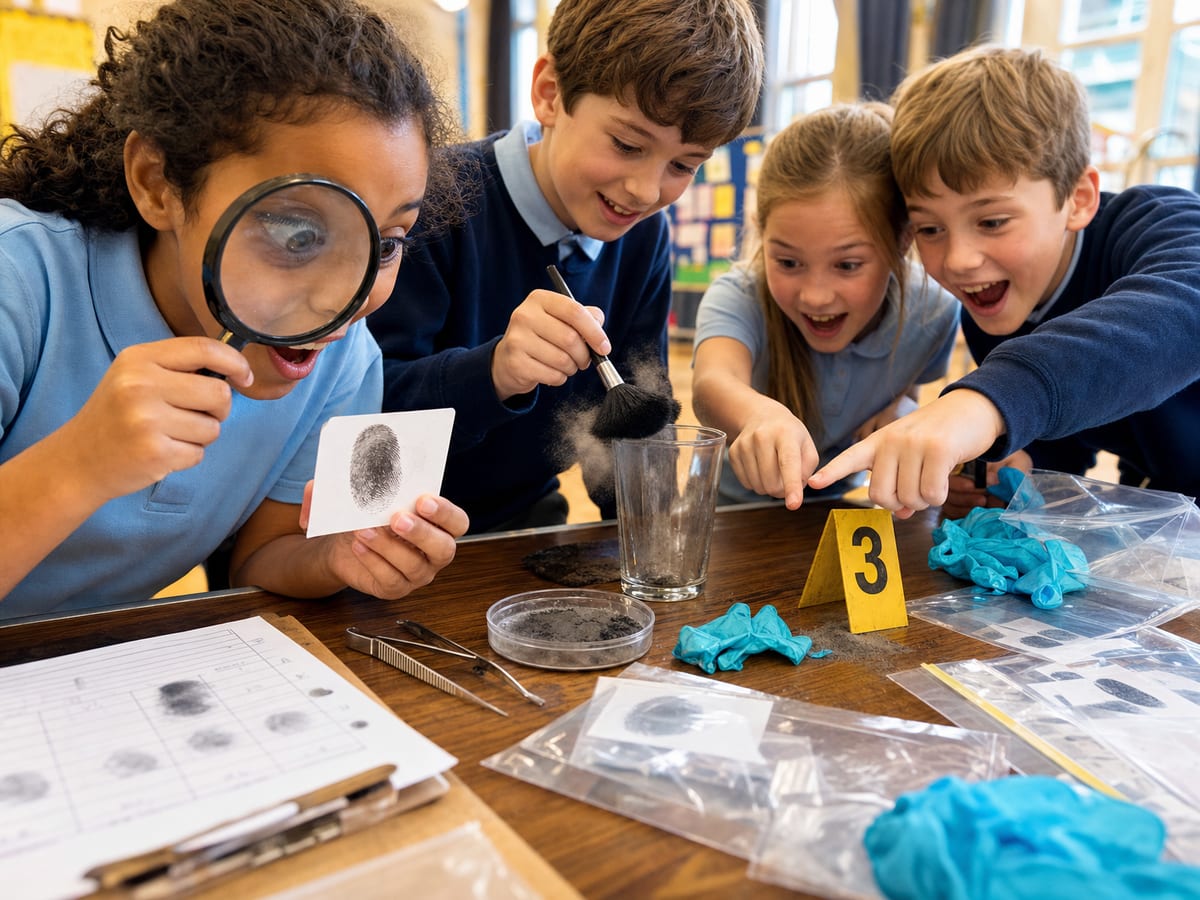
We had two workshops at our school: one on fossils for our younger students and the other exploring forensics for our older ones. Both were excellent and the students were engaged and enthusiastic. We are going to book the two workshops again for the summer term.
Also popular
Pairs well with
 Hands-on
Forensic Science
A crime has been committed. The class has to solve it.
KS1 - KS245 - 60 minutes VR
VRMinibeasts in VR
The garden, seen from a beetle's point of view.
EYFS - KS245 - 60 minutes VR
VRWild Animals in VR
Stand inches from wild predators, feeling their raw power in Virtual Reality.
EYFS - KS245 - 60 minutes