Science Faction
Live experiments with the wow factor - and the concept behind it.
About this workshop
Our experiments bring the wow factor while demonstrating the key concepts your teachers are already covering.
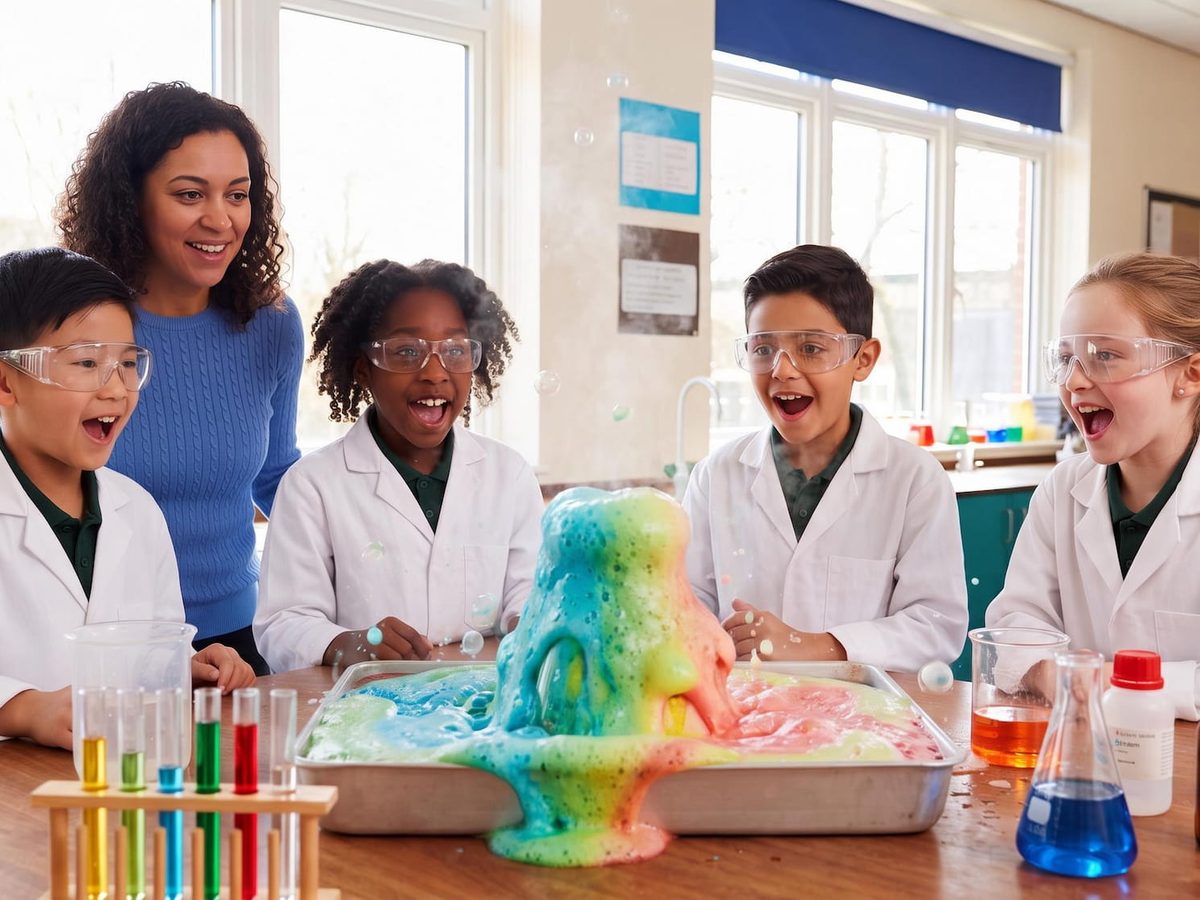
Chemical chaos: watch science get bubbly and explosive - ever made toothpaste big enough for an elephant, or a colourful lava lamp? Sound explorers: sound is made when things vibrate, and the bigger the vibration, the louder the sound. Forces and motion: fizzy rockets show how forces push back and make things fly.
Plants and water transport, material detectives and fog rings round out a session that is genuinely spectacular and genuinely about the curriculum. Perfect for the whole school.
How the session runs
What happens
- 01
Firstly, colour on the move
We start with coloured water climbing strips of kitchen roll from full cups into empty ones, no pouring involved. Where two colours meet they make a third - blue and yellow to green, red and yellow to orange.
- 02
Next, why things float
Then we stack oil on water and watch them refuse to mix, because one is less dense than the other. An effervescent tablet sends coloured water rising and sinking through the oil like a lava lamp.
- 03
Then, a reaction that launches
A tablet and a splash of water go into a sealed canister, pressure builds, and the lid loses - Newton's third law in one bang. Pupils change the recipe and test their predictions against the ceiling.
- 04
After that, foam by the bucket
Hydrogen peroxide, washing-up liquid, colouring and yeast make our elephant's toothpaste. The yeast speeds up a reaction that would otherwise crawl, and the beaker comes out warm - the reaction gives off heat.
- 05
Then, electricity and sound
The class holds hands to close a circuit through themselves, which introduces conductors and insulators. A nut spun inside a balloon screams, and a bubble on a horn shows how sound waves travel.
- 06
Finally, the air you cannot see
We finish with air proving it takes up space - a cup of tissue goes underwater and comes back dry. Then an air cannon fires a smoke ring the length of the hall to knock cups off a table.
What pupils will learn
The science they take away
Real life demonstrations make core scientific concepts vivid and memorable.
- 01That changes of state and chemical reactions can be observed and described
- 02How sound is produced by vibration and travels to the ear
- 03How forces act in pairs to produce motion
- 04How water travels through a plant by capillary action
- 05Why some materials float and others sink
- 06That air is a material with properties, even though it is invisible
Curriculum links
What this covers in the National Curriculum
Science - Working scientifically
- Understand that a hypothesis is a prediction made before an experiment, and that experiments test ideas.
- Understand that substances have different densities, and that density and buoyancy decide whether an object floats or sinks.
- Understand that a chemical reaction can produce a gas, and that some reactions give off heat as well as new substances.
- Understand that forces cause movement, and that every action has an equal and opposite reaction.
- Understand that electricity flows only in a complete circuit, and recognise the difference between conductors and insulators.
- Understand that sound is produced by vibrations and needs a medium to travel through, which is why it cannot cross a vacuum.
In your school
The eruption gets their attention. The question afterwards keeps it.
Logistics
What we bring, what you need
We bring
- All apparatus, chemicals and consumables for every demonstration
- A DBS-checked facilitator to lead every session
- Risk assessment specific to the demonstrations performed
- Protective equipment where the experiment calls for it
You provide
- A hall or classroom with space for the demonstration bench
- Access to water
- A member of school staff present in each session
Questions schools ask
Before you book
- Is it safe with the class close by?
- Yes. Every demonstration is risk-assessed, distances are set by the facilitator and pupils are positioned before anything starts.
- Can it run as an assembly?
- Yes. It works as a whole-school assembly or as class sessions across the day.
- Do pupils take part or just watch?
- Both. Several experiments use volunteers, and the whole class predicts and explains throughout.
- Will it make a mess?
- The spectacular ones are contained on trays and we clear up completely afterwards.
Feedback from schools
What schools said
Five-star Google reviews of Education Group, who deliver our workshops. Reviews naming this workshop come first.
We had a great experience with our science forces workshop. Ben was absolutely amazing and engaged the parents and the children in a fun-packed way. He made science exciting and memorable for my year 3 class. I would certainly book again!
We had a Science fraction workshop for the whole school, 1 class at a time. All children and staff enjoyed the workshop, and were impressed with the presenters adaptations for different aged children and our send unit. I would highly recommend this.
Excellent, fun. so much science covered, interactive, the kids enjoyed it, and scientific skills such as making predictions and conclusions were practised throughout.
Also popular
Pairs well with
 Hands-on
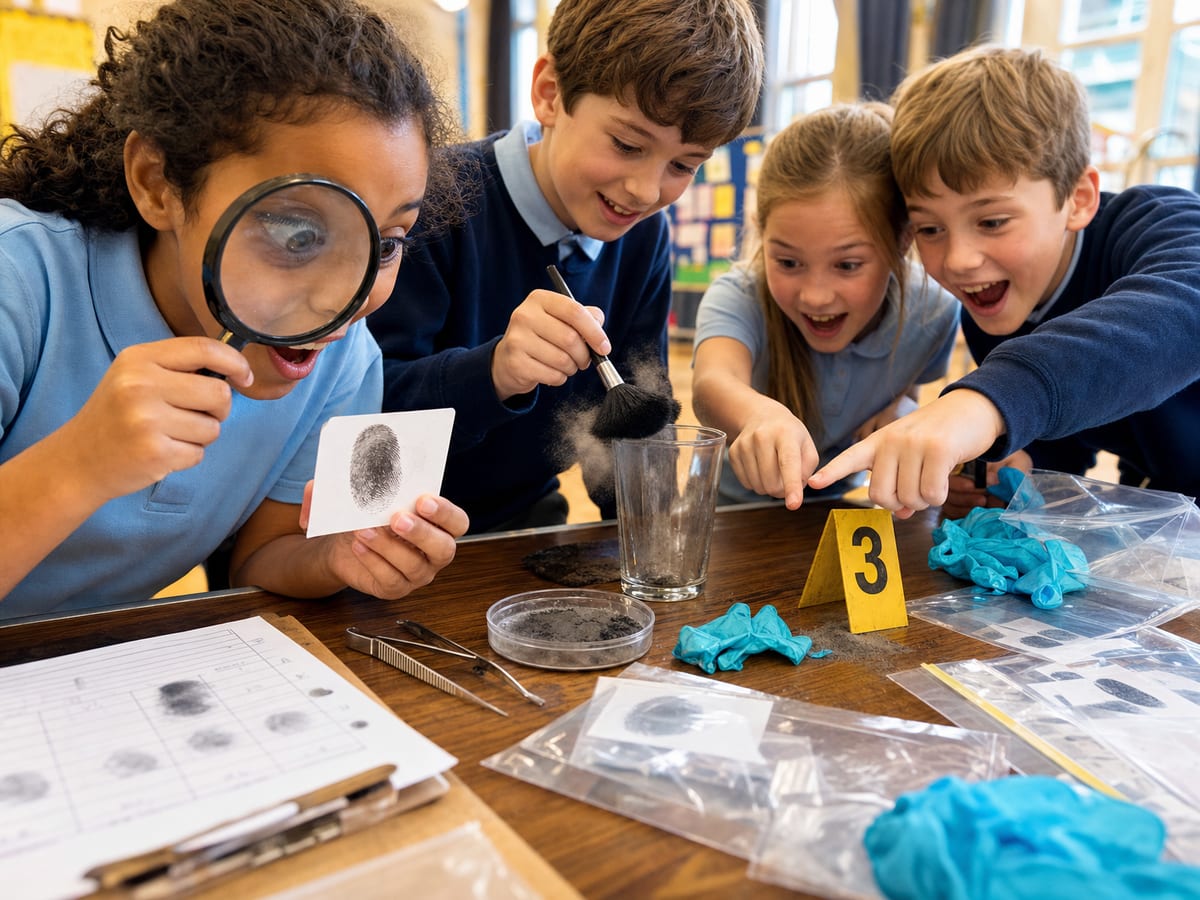
Forensic Science
A crime has been committed. The class has to solve it.
KS1 - KS245 - 60 minutes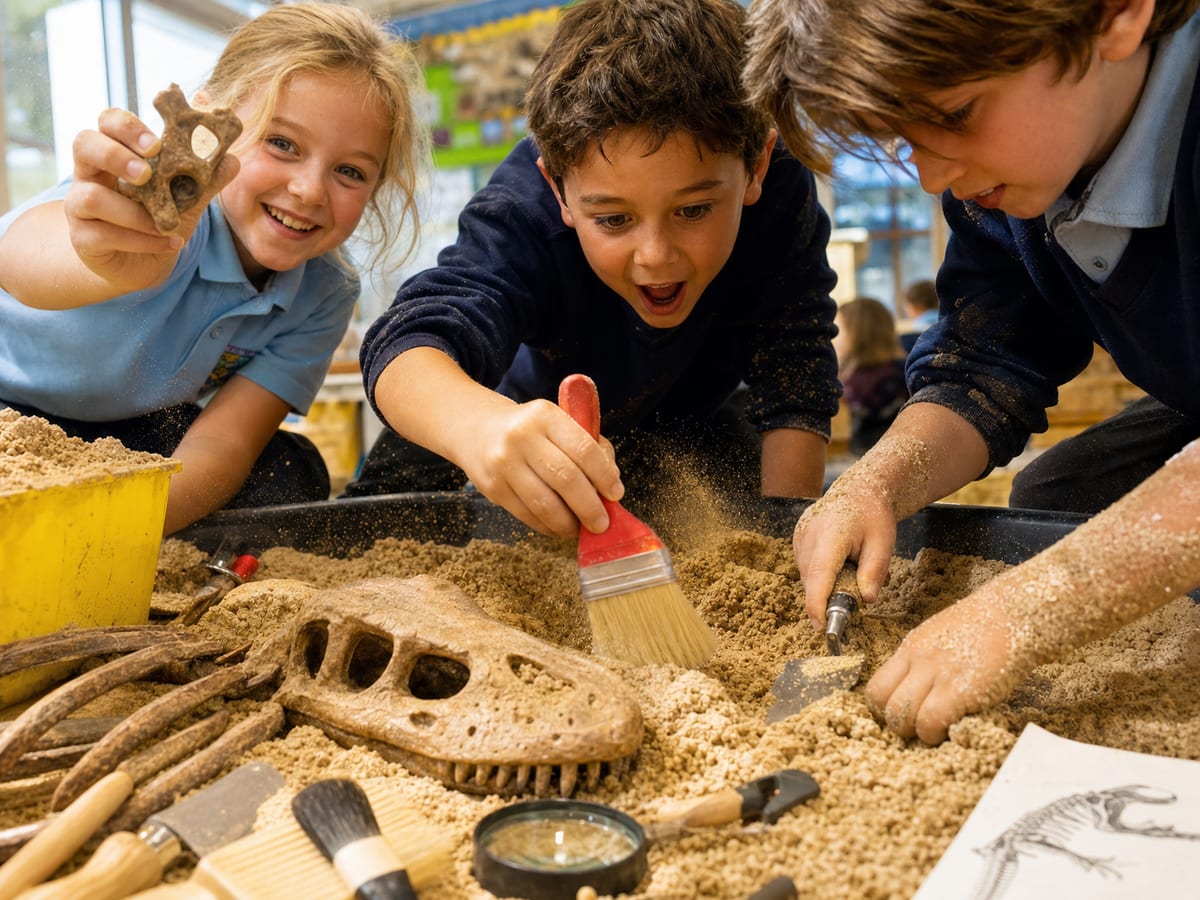 Hands-on
Dinosaur & Fossil Dig
Hands-on digging for replica fossils.
EYFS - KS245 - 60 minutes VR
VRHuman Body in VR
Shrink to the size of a molecule and look at the inner workings of the human body.
KS1 - KS245 - 60 minutes